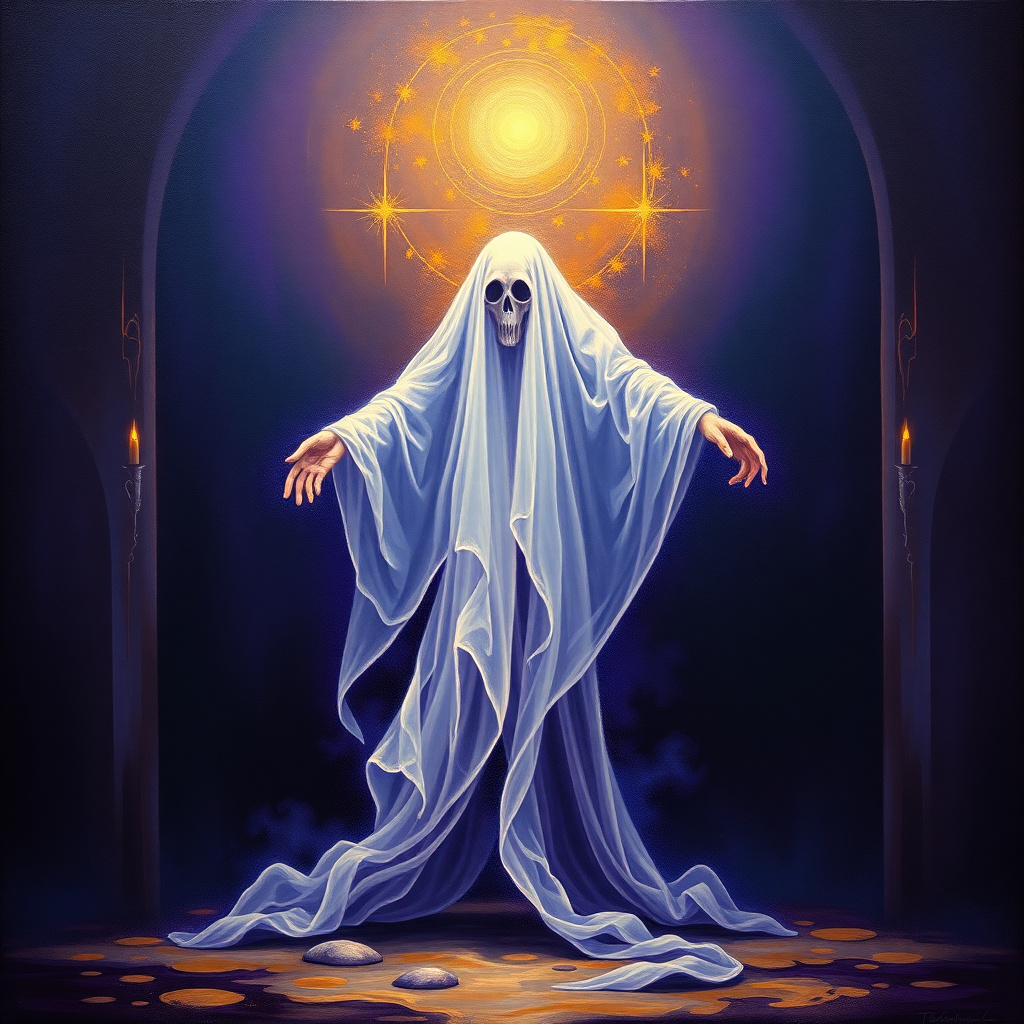
Ghost Dream Meaning: Mythological and Cultural Interpretations
Explore the cultural and mythological significance of a Ghost in your dreams, from ancestral spirits to Shakespearean archetypes and folklore.
To encounter a Ghost in the realm of sleep is to step into the shared tapestry of human folklore and ancient myth. Throughout history, the appearance of a specter has rarely been viewed as a mere trick of the mind; instead, it serves as a bridge between the terrestrial and the divine, the living and the dead. Whether viewed as a restless shade from Greek tragedy or a venerated ancestor in Eastern traditions, the Ghost acts as a messenger from a plane of existence that operates outside the constraints of linear time and physical matter.
What does your Ghost dream mean?
What is the Ghost's manner of presence?
The Specter as Ancestral Messenger and Divine Warning
In many Eastern and indigenous traditions, the appearance of a Ghost is not an omen of dread, but a profound moment of spiritual communication. In various Asian mythologies, ancestor spirits remain tethered to the family lineage to offer guidance or to demand the fulfillment of neglected rites. When a Ghost manifests, it may signify a breach in the cosmic order—a debt unpaid to the lineage or a ritual forgotten. This is not a matter of individual psychology, but of communal and spiritual duty. The specter acts as a guardian of tradition, ensuring that the wisdom of the past is not discarded by the living. In these cultural frameworks, the Ghost is a bridge, maintaining the continuity between generations. If the spirit appears calm, it may represent the blessing of the lineage; if it appears agitated, it suggests a disruption in the ancestral flow. Similarly, in various African and Oceanic traditions, spirits of the departed serve as mediators between the mortal realm and the higher gods. The Ghost is an agent of the divine, appearing to signal that the laws of the universe are being tested. This perspective shifts the focus from the self to the cosmos, suggesting that the presence of a specter is a call to realign one's life with the sacred laws and historical rhythms that govern all existence. The Ghost is therefore a vital link in the chain of being, reminding the living that they are merely one chapter in a much larger, eternal narrative that includes those who have passed through the veil.
Classical Archetypes and the Shakespearean Shade
Western literary and mythological traditions often frame the Ghost through the lens of the 'restless shade' or the 'avenging spirit.' Drawing from the Greek concept of the Hades-bound shades, a Ghost is often a figure caught in a state of liminality—neither fully gone nor fully present. This archetype is most famously crystallized in the works of William Shakespeare, where the Ghost serves as a catalyst for cosmic justice and the restoration of order. Like the Ghost in Hamlet, the specter represents a disruption in the natural law, appearing to demand retribution for a crime that has stained the fabric of reality. In this context, the Ghost is an embodiment of unresolved history and the weight of past actions that refuse to remain buried. It is a manifestation of the 'unresolved,' a figure that haunts the periphery of the conscious world to ensure that truth is eventually brought to light. Unlike the benevolent ancestor, this type of Ghost is often a figure of tragic necessity, driven by a specific purpose that transcends personal desire. The presence of such a specter in myth often signals a period of upheaval, where the old structures of power are being challenged by the truths of the past. This is a narrative of justice and consequence, where the Ghost functions as the moral conscience of a kingdom or a household, appearing when the scales of fate have become unbalanced. The specter is the voice of the past demanding a reckoning, ensuring that no deed, no matter how hidden, escapes the gaze of destiny.
Liminality and the Folklore of the Haunted Threshold
Folklore across the globe frequently places the Ghost at the 'threshold'—the boundary between the known and the unknown, the domestic and the wild. In European folklore, the concept of a 'haunted house' is less about a building and more about a space where the veil between worlds has worn thin. When a Ghost appears in a specific setting, such as a mirror or a doorway, it is occupying a liminal space. In many mythologies, mirrors are seen as portals or windows into the spirit realm, and a Ghost appearing within one is a sign that the boundaries of reality are dissolving. This phenomenon is deeply rooted in the idea of the 'thin places,' locations where the physical world and the spirit world overlap. The Ghost in these narratives is a creature of the twilight, existing in the gray areas of existence. This is reflected in various tales of poltergeists or spirits that move objects; these are not mere disruptions, but signs of a spirit attempting to exert influence from a dimension that lacks physical agency. The Ghost becomes a symbol of the 'unseen influence' that governs the world, reminding us that much of reality exists just beyond the reach of our senses. This cultural lens views the Ghost as a reminder of the mystery of existence, an inhabitant of the shadows that proves the world is far more complex and layered than the material plane suggests. The Ghost is the inhabitant of the threshold, the eternal traveler between the light of life and the shadow of the void.
Frequently Asked Questions
What does it mean when you dream about ghost attacking me?
From a mythological perspective, a Ghost attacking is often interpreted as a confrontation with a 'vengeful shade' or an unresolved ancestral debt. In folklore, this represents a disruption in the spiritual order where a past transgression or a broken taboo is manifesting as a direct conflict between the mortal and spirit realms.
Why did I dream about ghost moving things?
In many cultural traditions, a Ghost moving objects is seen as a sign of a 'liminal presence' attempting to communicate or exert influence from the veil. It suggests that the boundary between the physical and spiritual worlds is thin, and the spirit is attempting to bridge the gap through physical manifestation.
What does it mean to dream about ghost in mirror?
In various mythologies, mirrors are considered portals to the afterlife or the spirit world. Seeing a Ghost in a mirror is often viewed as a glimpse into the 'other side,' signifying a moment where the veil has parted, allowing a direct visual connection to the realm of the shades.